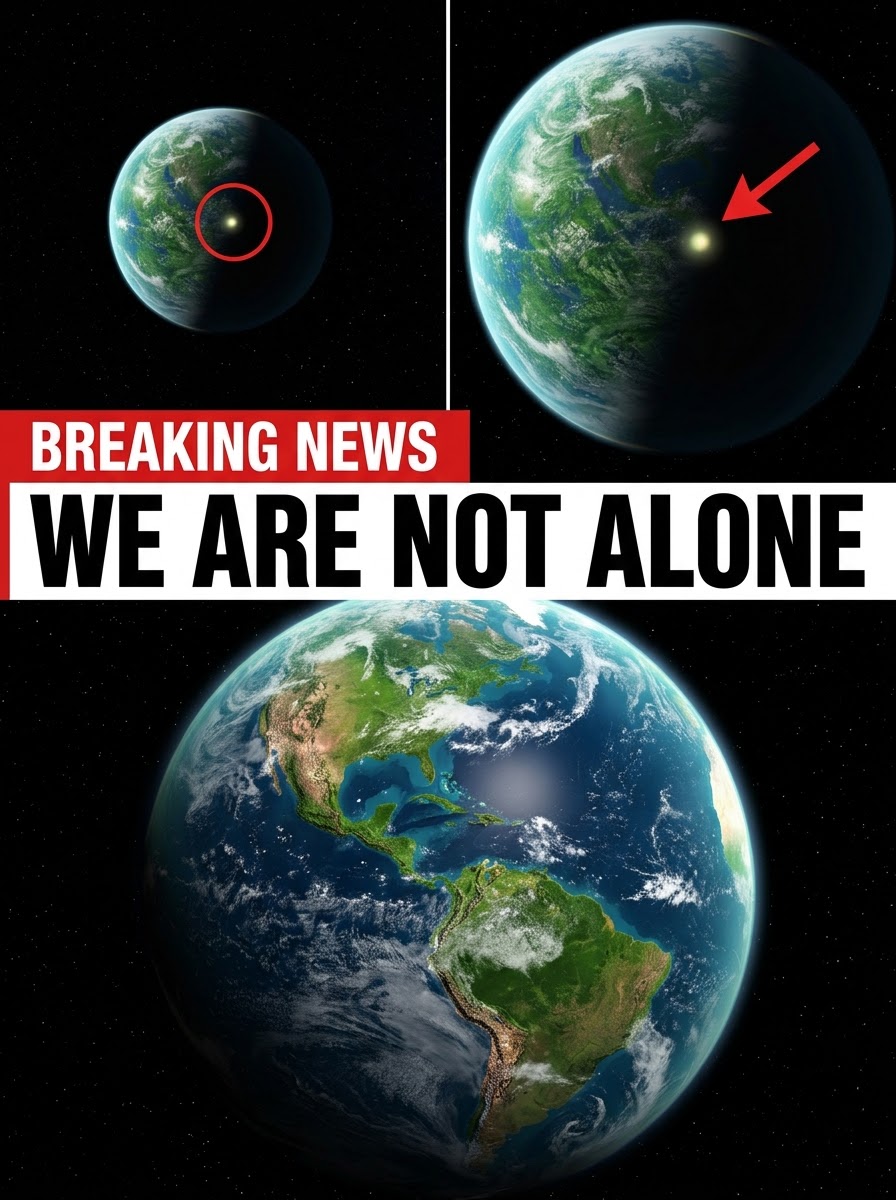
James Webb Telescope May Have Detected a Potentially Habitable Planet
For decades, scientists have searched the universe for evidence that life may exist beyond Earth. Now, observations from the James Webb Space Telescope have brought that search back into the spotlight.
The telescope has detected intriguing signals from the atmosphere of a distant exoplanet. Researchers are studying these signals because they may reveal important information about the planet’s environment and whether it could potentially support life.
A Signal Hidden in Infrared Light
The James Webb Space Telescope is designed to observe infrared light, allowing scientists to study the atmospheres of planets orbiting distant stars.
By analyzing how starlight passes through a planet’s atmosphere, researchers can identify the chemical fingerprints of different gases.
In this case, the atmospheric data have revealed a combination of chemical signatures that has attracted scientific attention.
An Unusual Atmospheric Chemistry
One of the most interesting aspects is the apparent presence of several gases existing together in a complex chemical balance.
On Earth, certain atmospheric chemical combinations can be associated with biological activity. However, scientists cannot automatically assume that the same explanation applies to another planet.
Non-biological geological and chemical processes can also produce similar signatures.
That means these observations should be considered potential clues—not proof of extraterrestrial life.
Could the Planet Support Life?
Another important question is whether the planet exists in conditions that could allow liquid water and other ingredients considered important for life.
Its location relative to its host star and the characteristics of its atmosphere are therefore particularly important.
If future observations confirm that the planet has a stable atmosphere and suitable environmental conditions, it could become an important target for further research.
Possible Biosignatures
Scientists are especially interested in molecules that, on Earth, can be produced by biological processes.
Finding such molecules on another planet would be exciting. But even then, researchers would need to rule out alternative explanations before claiming that life had been discovered.
This is one of the biggest challenges in the search for extraterrestrial life: a potential biosignature is not the same thing as a confirmed life signature.
What If the Evidence Is Confirmed?
If future observations demonstrate that the atmospheric signals are genuinely connected to biological activity, the discovery could transform our understanding of life in the universe.
It would suggest that the conditions required for life may not be unique to Earth.
The question would then change from “Is there life beyond Earth?” to something much bigger:
How common is life throughout the universe?
Scientists Still Need More Evidence
Extraordinary claims require repeated observations and independent verification.
Researchers will need to determine whether the atmospheric signatures remain consistent over time and whether natural processes can explain what the telescope is detecting.
For now, the discovery should therefore be viewed as an intriguing scientific possibility rather than confirmation of an alien world.
The James Webb Space Telescope is giving scientists an unprecedented ability to study distant exoplanet atmospheres.
And perhaps, with enough observations, it may eventually help answer one of humanity’s oldest questions:
Are we truly alone in the universe?
Leave a Reply